On April 8, the nation will experience a dramatic total eclipse. If you want fun ways to see it, check out our recommendations, from skiing to hiking to paddling.
• Share to Outside FeedCreate a new post with the article attached • Copy link • Email • Share on X • Share on Facebook • Share on Reddit
New perk: Easily find new routes and hidden gems, upcoming running events, and more near you. Your weekly Local Running Newsletter has everything you need to lace up!Subscribe today.
Monday, April 8, 2024, will be an epic day, when a total eclipse passes over North America. The moon will completely block out the sun, turning day to night across a wide swath of the United States from Texas to Maine. All of us in the nation, wherever we’re located, will experience at least a partial eclipse. If you’re in Southern California, the moon will blot out about half of the sun; in Washington State, about 30 percent; and in the mountains of North Carolina, roughly 80 percent.
Total Solar Eclipse 2024: The Path of Totality
If you’re situated directly beneath the celestial event, in the path of totality—which diagonals from Northern Mexico into Texas, up through to Maine, and out over Canada—you’ll get the full experience. See thepath of totalityhere (use link to download NASA’s interactive map).
“A total eclipse is other-worldly,” says Tyler Nordgren, an astronomer and Dark Sky Ambassador for the National Park Service. “Thesky will get dark, colors in the landscape will change. During totality, you’ll go from daytime to night, the brightest stars turn out, and the sun turns into a black hole in space. The heavens literally align above you.”
Anannular eclipse passed over the western United Stateslast October, and in 2017 some of us got to experience a total eclipse (my kids and I watched from a beach in South Carolina), but this impending eclipse will be even more dramatic, promising twice as large an area of totality as in 2017, because the moon is closer to earth and will cast a larger shadow.
Nordgren’s advice for choosing a spot to watch? “Go some place you actually want to visit, because if you get clouded out, you’re somewhere cool.
“Even with socked-in skies,” he adds, “you’ll notice things getting darker, and then it will be dark as night. You’ll experience a truly bizarre day.”
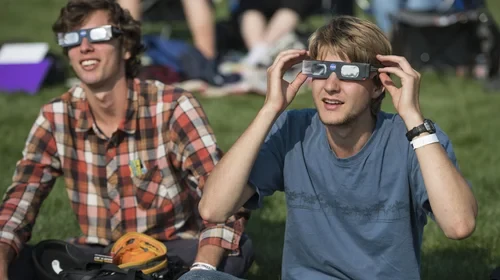
We’ve picked seven badass places with fun things to do to make the most of your viewing opportunity. Just don’t forget yourprotective eyewear.
How toSee the 2024 Total Solar Eclipse in Adventure-Worthy Ways
1. From a Ski Resort: Jay Peak, Vermont
For a party, look no further thanJay Peakand theirWhiteout bash, which will feature live music from Pink Talking Fish as they perform the Pink Floyd album Dark Side of the Moon in its entirety. You can expect about four minutes of total darkness during the peak of the event. The lifts will be running before the eclipse starts at 2 P.M., but will stop for the duration of the event. Scenic tram rides to the top of the mountain are booked solid, but to avoid crowds anyways, catch one of the last chairs and ski to a quiet spot on the mountain.
Jay isn’t the only resort stoked on the eclipse. Saddleback Mountain, in Maine, will roll its end-of-the-season festivities straight into aLights Out Partythat day. Whiteface in upstate New York, also Stowe, Sugarbush, and Mad River in Vermont, and Loon and Cannon Mountains in New Hampshire are all planning watch parties, too.
2. From a Canoe: Buffalo National River, Arkansas
The Buffalo National River—the first ever designated in America—flows freely across the state of Arkansas for 135 miles, and the majority will be within the path of totality. You can expect roughly 3:30 minutes of total darkness within the park. TheBuffalo National Riveris also a designatedInternational Dark Sky Park, where in the days leading up to the eclipse rangers and astronomy experts will lead various interpretivenight-sky programswith the chance to view constellations through telescopes.
For the event, we suggest you ditch the crowds by heading into the backcountry via canoe. The Upper Buffalo is the most scenic area of the river, with 200-500-foot bluffs rising directly from the water. The paddle is generally mellow, but some class I rapids keep things interesting. You can choose from a 10-mile day trip from the Ponca put-in to Kyles Landing, or do an overnight or multi-day, pulling off at gravel sandbars to set upcamp. Or go crazy and try to knock out the entire 135 miles in a 10-day trip. Backcountry camping permits are free, and theBuffalo Outdoor Centerhas rentals (from $75 a day).
3. From Among Ancient Earthworks: Mounds State Park, Indiana
Moundsisn’t the most adventurous state park—it’s only 290 acres and most of the trails are crushed gravel and boardwalks—but it’s a cultural hotspot protecting 10 awe-inspiring earthworks along the White River built by the pre-Columbian Adena and Hopewell cultures. Historians believe that the largest of the mounds, the Great Mound, dates back to around 160 B.C. and that the mounds were used for community gatherings, religious ceremonies, and, yes, viewing astronomical alignments.
Savor that history by showing up to witness 3:42 seconds of total darkness as the eclipse passes over the park in the afternoon. You can watch from beside the Great Mound or by one of the other earthworks, or hike trail #5, a 2.5-mile loop that weaves around the park, past various mounds and along the banks of the White River. Bring your fishing gear, or grab what you need from nearbyDunham Sports, and be prepared to cast, as the trail accesses the river in several points; the White is known for its smallmouth bass fishing.
4. From a National Forest: Garden of the Gods, Illinois
The whole 289,000-acre Shawnee National Forest sits within the path of totality, but the most dramatic spot for viewing has to beGarden of the Gods Recreation Area, a swath of sandstone outcroppings and cliffs that may be 320 million years old, according to the U.S. Forest Service. The .25-mile Observation Trail wanders through the heart of theGarden of the Godsoutcroppings and to the top of tall bluffs with long-range views of the Shawnee Hills. These bluffs make a perfect perch for viewing the eclipse, which will hover over the area for 3:27 minutes of total darkness.
Pharaoh Campgroundhas 12 first-come, first-served sites ($10 a night), but you better show up a few days early to snag a site before everyone else does. If you want more solitude, wander into Garden of the Gods Wilderness via theIndian Point Trail Loop, which forms a 1.6-mile lollipop loop through a pine forest with bluff-top overlooks, caves, and rock formations.
5. From a Tube: Garner State Park, Texas
Not only did a chunk of Texas experience the path of totality during the annular eclipse in October but the state will score it again. Moreover, among all the U.S. states in April’s eclipse path, this one has thehighest likelihood of a clear skyfor prime viewing. Weather data from the last 28 years predicts just a 30 percent chance of cloud cover.
Garner State Park, in Texas Hill Country, sits in the path of totality and will experience 4:30 minutes of complete darkness. The park itself protects 1,774 acres of hills, forest, and bluffs as well as 2.9 miles of the aptly named Frio River. (Yes, that means “cold”.) You’ll find plenty of trails to hike, but the real gem of this park is tubing the Frio as it winds around the campgrounds and below the tan sandstone cliffs (theconcessionairerents tubes for $10 each, per day). Tubing the stretch through the park takes a few hours, with a number of small rapids and the occasional swimming hole. Put in by noon (totality will start at 1:30 P.M.) and take your time.
6. From an Olympic Site: Adirondack Park, New York
At six million acres, upstate New York’sAdirondack Parkis the largest publicly protected landscape in the lower 48. And most of that park will be within the path of totality. While the region is typically cloudy in April, on Nordgren’s advice, we’re sending you here as a beautiful, adventurous place, whatever the weather. You can see the eclipse from a variety of vantage points inside the park, and Lake Placid is hosting aGlow for the Goldwatch party at the Olympic Center. They’re opening the speed-skating oval with views of the famous Olympic ski jumps and the Adirondacks’ High Peaks Wilderness Area. (An earlier version of this article suggested a mountain hike, but area groups are asking visitors to avoid the backcountry out of caution over potential winter conditions in April and given that mud season can lead to ecological damage from hiking. See other optionshere.)
7. From a Surfboard: Mazatlan, Mexico
The moon will cast a shadow over Mexico and the eastern edge of Canada as well as the U.S. While the chances of clear skies lessen as the eclipse moves north and into Canada, Mexico in early April presents the best chance for clear skies along the entire path of totality, with an 80 percent chance of sun during the day of the eclipse. But keep in mind the U.S. government has issued atravel advisoryfor Mazatlan because of the presence of drug cartels in the area. It’s the same level of advisory (more informationhere) that the government has issued for Mexico City, Puerto Vallarta, andBaja.
Check out Mazatlan, a colonial-era beach town north of the popular Puerto Vallarta that is actually the first location in North America where you can view the total eclipse. It’s a legitimate surf destination with beaches facing multiple directions, picking up solid swells year round. Rucos, north of town, offers reliable surf spread across four miles of beach, though you’ll need a 4×4 vehicle to reach it. Or, to keep things simple, walk from Mazatlan’s Centro Historico, a revamped historic district in the heart of town, to Playa Olas Altas to surf abeginner-friendly beach break.Jah Surf Schoolhas lessons (from $50 a person) and rentals ($25 per day).
Now that we’ve given you the best places to see the solar eclipse in 2024, plot out your adventure and make the most of this celestial event. The next total eclipse won’t cross the lower 48 for 20 years.
Graham Averill isOutsidemagazine’s national parks columnist. He can never remember the names of the constellations in the sky, but loves a good eclipse and has fond memories of the 2017 event, which he watched with his family during a beach vacation.
The 6 Most Adventurous Train Trips in North America
The 10 Best Backpacking Trails in Our National Parks
The Worst National Park Reviews of the Year
• Arkansas • Biking • Canoeing • Fishing • Hiking • Illinois • Indiana • Maine • Mexico • New York • Skiing • Texas • Vermont